
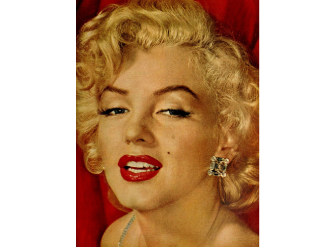
The lips, plump and red, are parted slightly, as if on the brink of speech, about to declare love, perhaps, or a secret. The eyes, heavy-lidded and slightly closed, had winged lashes, thick enough to create actual shadow. A small dark beauty mark dots the smooth whiteness of the left cheek. And surrounding the face is a luminous halo of platinum blonde hair.
You will know this face. Though Marilyn Monroe died in 1962, when she was just 36 years old, her image remains as recognisable as Coca-Cola – the product it has been used to advertise for seven decades. Marilyn would have turned 100 this year, and still that youthful face is deployed across the US, China, and Europe to sell soft drinks, cosmetics, chocolate, designer shoes, and handbags. She remains the archetypal all-American girl, ready for anything: equally happy in pedal pushers eating hotdogs with Joe DiMaggio, and poured into a sheer, flesh-coloured gown to sing Happy Birthday to President Kennedy at Madison Square Garden.
It’s the very malleability of Marilyn’s face, and the fact that her image was frozen in its prime, that makes it so enduringly sellable. But it isn’t a natural face, it was carefully constructed.
Most people know that Norma Jeane started out as a brunette. She arrived in Hollywood with a face that was lovely if unremarkable. She modelled for the Blue Book agency in the mid-1940s, while her first husband James Dougherty was deployed in the Marines. The marriage was partly convenience; in keeping with the lonely and tumultuous private existence that lay behind the Hollywood glamour, they had married when she was just 16, and he 20 to prevent her returning to the orphanage. By 1946 when Marilyn had become a successful pin up model, the couple divorced.
Monroe the movie star emerged out of a careful collaboration between Marilyn and her makeup artist Allan ‘Whitey’ Snyder: together they fashioned her face into a language shaped for the screen, and for visual impact. That cartoonish perfection, from the eyes to the lips, to the pale foundation, mixed to a custom formula to catch the studio lighting, was deliberately stylised and reproducible. It would position her at the epicentre of a burgeoning commercialism in art and culture, from the pop art of Andy Warhol to the nylon tights and bullet bras that would mark the ‘accessible’ glamour of the modern woman.
Marilyn could walk through New York with her face unpainted, wearing flat shoes and a headscarf, and be entirely unrecognised – even at the height of her fame. Through a self-conscious transformation, like a musician picking up her violin, she was one with her instrument: the face, the body, the movement, each quiver perfectly calibrated to invoke desire.
The manufacturing of Marilyn extended to surgery. Her medical records, sold at auction in 2013, included facial X-rays and notes from the office of Dr Michael Gurdin. A ‘chin deformity’ was noted, along with the 1950 cartilage implant that corrected it, and a tip rhinoplasty that produced that snubbed nose.
It was a face that was constructed along explicitly racial lines: platinum, Anglo-Saxon, soft-featured, white, and that reflected the post-war environment. Leading ladies of the Depression had been angular and emotionally remote – think Greta Garbo and Marlene Dietrich, with their sharp, hungry features and mysterious auras. By the 1940s, resilience and wartime spirit were written into the faces onscreen: Rita Hayworth’s defined cheekbones, Lauren Bacall’s sultry angularity, Ingrid Bergman’s classical elegance. Then, as rationing lifted in 1945 and prosperity returned, Marilyn’s fuller lips, luminous skin, and rounded, expressive features suggested vitality and openness rather than distance or control. Hers was the face of consumer capitalism – soft, inviting, full of promise.
What is striking, a century on, is how deliberately that template was deployed beyond cinema. The ‘blonde bombshell’ was not merely a beauty ideal but a geopolitical instrument that American culture projected to the world during the Cold War, when Hollywood functioned as a kind of soft-power embassy. The Voice of America – a US government -funded broadcaster established in 1942 to counter Axis propaganda – existed to promote positive ‘American’ values internationally.
Today, in the Trump administration, it has been noticed that ‘Mar-a-Lago face’, so characteristic of the MAGA elite, has come to define visible, effortful wealth, with the heavy use of face and brow lifts, fillers, sculpted cheekbones and Botox. By contrast, Marilyn’s face promised girl-next-door accessibility, with her whiteness personifying the ‘milk and honey’ modernity of modern America. To a large degree, this privileging of European beauty standards remains at the heart of the Hollywood project: white skin, blonde hair, light eyes, a slender nose and heart-shaped face is core to cinema and advertising, despite the language of diversity.
In private, Marilyn pushed against this narrow politicisation; released FBI files reveal she was under surveillance for her ‘strong feelings for civil rights, for black equality’, and for speaking out against McCarthyism. The Norma Jeane inside the Marilyn mask was a serious and politically aware woman who read Dostoevsky and started her own production company – despite Hollywood being even more dominated by men than it is today.
We can’t separate the power and desirability of Marilyn’s image from the technology that circulated it around the world. In cinema, it was the rapid switching between characters and the close-up, popularised by directors such as D.W. Griffith in the 1910s – most famous for Birth of a Nation (1915) – that brought faces to audiences at a scale and intimacy never experienced. For the first time you could pay your 3 shillings and six pence and sit in a darkened room, with a perfect, emoting face projected 20 feet high in front of you. This face-to-face intimacy was key to the creation of Marilyn as a celebrity – along with colour film common by the 1940s – that brought her peach skin and red lips to life.
Perhaps the most famous reproduction of Marilyn’s image is the series of silkscreens Andy Warhol made in 1962, immediately after her death. Warhol’s work explored the mechanisms of fame, the way an image could be taken and reproduced until it becomes entirely separate from the person it depicted. Warhol made this separation of person and image explicit, along with the commercial reproducibility of the stereotype: bright pink skin, yellow hair, blue eyelids. Reduced to a logo. He reproduced the lips alone, 84 times, across two panels.
By 1962, Marilyn’s face had appeared on so many magazine covers, movie posters, and newspaper front pages that familiarity had become abstraction, in the same way perhaps that her private pain was separated from her public persona. Removed from the flesh and blood woman and placed alongside a Campbell’s soup can and a Coca-Cola bottle, Marilyn’s face became a caricature, instantly recognisable by the beauty mark alone.
Many famous women have since picked up elements of Marilyn’s physicality: from Anna Nicole Smith to Madonna, the ‘material girl’s lips, hair and beauty spot have become a shorthand for Western glamour, beauty and sex.
And then there is Kim Kardashian, who wore Monroe’s iconic 1962 Jean Louis rhinestone encrusted dress to the Met Gala in 2022. Kardashian has built her own cultural identity as carefully as Monroe did, but there is a critically different emphasis, and context. Where Marilyn’s face became a caricature through cultural reproduction – a meeting of technology, art and consumerism – Kardashian’s became one by design. Like Marilyn’s stardom, Kim’s is based on appearance, and on the technology of the screen (in Kim’s case, social media). But the Kardashian brand is based on homogeny rather than uniqueness. Drawing on Black, Latina and Middle Eastern beauty traditions that are repackaged through a light-skinned lens – large lips, catlike eyes, narrowed noses, heavy bronzer, thick brows – there is no singular face at its core.
There is, however, a singular butt, which is said to have caused irreparable damage to the Marilyn’s hand-me-down dress – despite reportedly losing 16 pounds in three weeks to squeeze into it.
What is singular and yet universal about Marilyn’s face is its idealization. What is so enduring about Marilyn’s face, beyond its celebration of consumerism, youth and the West, is its paradoxical blankness: it is simultaneously both filled with meaning and empty enough for other meanings to be attached to it: she stands for emulation and desire, gullibility and shrewdness, sex and innocence, madonna and whore. These contradictions echo the fundamental contradiction in Marilyn’s own life: the child-woman who was never loved enough and the dazzling beauty with the world at her feet. That duality was visible in her half-closed eyes, her parted mouth – each readable as a sign of desire, or submission.
In 2011, Authentic Brands Group acquired the rights to Marilyn Monroe’s face and name, managing her estate alongside the Bob Marley estate and a mixed martial arts clothing line. The labour that went into the creation of an icon has been glossed over, and all we are left with is the artistry, as the image is reproduced endlessly and everywhere, from high-art museums to streetwear, murals and social media.
This year, Marilyn would have been 100 years old, prompting an outpouring of articles and exhibitions that show she still matters. See, for example, the wonderful new exhibition at the National Portrait Gallery in London, curated by Rosie Broadley.
Had Marilyn lived, images of her sagging face and ‘lost’ beauty would no doubt be circulating on Instagram and TikTok. Without the woman, there is just the myth, and the false promise of enduring youth. And in an era of deep fakes, fillers and digital transformations, that gap between the reality and the promise matters more than ever.